Titan Quest II
Setting off into the (un)certain
Before we begin this review, I must declare a conflict of interest! There are several reasons for this. First, I really enjoyed playing the first Titan Quest back then. Admittedly, it was a time when games had to do a lot wrong for me not to enjoy them. But Titan Quest was simply a very good action role-playing game/hack and slash/Diablo set in ancient times, which was particularly appealing when played cooperatively with friends and family (aka my brother).
I look back on the series (and its music) with nostalgia and still enjoy listening to the soundtrack, whose main theme, Titan Quest , has become pleasantly engraved in my brain. Like many fans, I had given up hope of ever seeing anything from the brand again, which had been dormant for a good ten years after the Immortal Throne expansion. But then, in 2017, a series of additional add-ons for the Ragnarök, Atlantis (2019) and Eternal Embers (2021), appeared unexpectedly for the Anniversary Edition , which I never got around to trying due to lack of time.
Let's jump four years ahead to the future and arrive in the present. Titan Quest II , a true successor, is now just around the corner – or rather, already has one foot over the doorstep. The game from Munich-based developer Grimlore Games, who are responsible for the thoroughly solid SpellForce 3 and its add-ons, is currently in early access. Even though I've already bought the game to show my support (and because it's probably cheaper now than it will be when it's fully released), I'll only take a quick look. I'll leave the testing to enthusiasts and impatient gamers; I can easily wait until the game is finished. With a planned release date next year, the team has enough time to listen to feedback from both fans and critics.
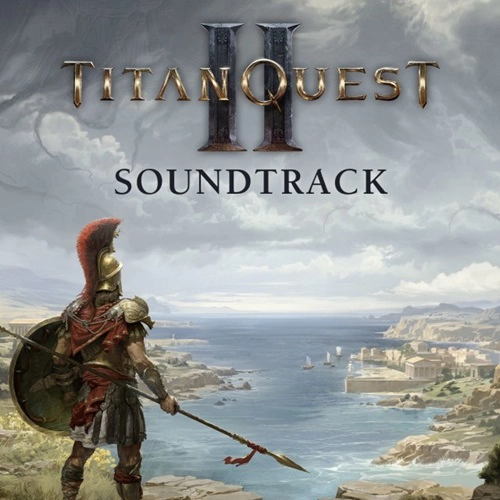
Listening is the keyword here, because in addition to early access, the soundtrack was also offered at a reduced price—and I can't say no to that. Considering the 19 tracks, the album is also a pretty fair deal at $3.99 (currently on sale). But as we all know, quantity doesn't say anything about quality, so let's move on to the review and the second reason for my bias.
The music of Titan Quest II , as with SpellForce 3, was composed by Bastian Kieslinger – and I had the opportunity to discuss his composition with him! Or, to put it another way: he came across my SF3-review and contacted me on Instagram. In the course of this, I asked him directly about TQ2 . For this reason, this review is not without bias, and the rating is accordingly mitigated, but I will still try to be as objectively subjective as possible.
With a new development studio and Kieslinger on board, this means that the original composers Scott B. Morton and Michael Verrette (only Morton in the add-ons) are no longer involved. I found their work for the first part to be very well done, especially the main theme mentioned at the beginning and its recurrence throughout the composition as a leitmotif, which I really liked.
Kieslinger feels the same way and said in the chat:
You're absolutely right, I loved (and still do) the menu theme and When Gods Fallwhich played in the credits back then! It's an honor for me, as it was with SpellForce, to be able to follow in such big footsteps, and I'm doing my best to make the music as good as possible!
Bastian Kieslinger, composer
Accordingly, I hoped for a logical continuation or allusion in the score of the sequel – but that didn't come to pass. As with the music for SF3 , there is no return to motifs from the predecessors, but primarily to their soundscape. That's not a bad thing, of course, but for me as a fan it's a bit of a shame.
For Titan Quest II , the composer acquired six ancient and modern Greek musical instruments. We get to see them together with him in this behind-the-scenes video . There, we also see and, above all, hear the Greek soprano Aphrodite Patoulidou (what a fitting name) intoning the ancient Greek texts. We are already familiar with this stylistic device from the predecessor, especially from the credits theme When Gods Fall (Credits), which Kieslinger highlighted. Patoulidou does an excellent job, lending tracks such as With It, or On It (Ḕ tā̀n ḕ epì tâs) and the Cinematic Trailer Theme Bound by Destiny from the video above gravitas and authenticity.
The focus on Greek/Mediterranean instruments is no coincidence, of course, as the Titan Quest-series has always been set in Hellenistic antiquity. While we still battle our way through Egypt and China in the later acts of the main game of its predecessor, the early access version of its successor is currently limited to the land of feta fetishists. It can be assumed that Titan Quest II will also explore other locations from the antiquity at a later date. Kieslinger himself confirms that the 19 tracks only cover the current state of Early Access and that the scope will be continuously expanded.
However, in my opinion, this limitation does not do the album any favors in its current form. After all, a high fantasy game like SF3, with no earthly counterpart, can draw on the full range of orchestration. Many of the pieces from Titan Quest II, on the other hand, seem more “interchangeable” and, simply because of the choice of instruments, have a similarity to other games with the same setting, such as Expeditions: Rome or, presumably, Anno 117: Pax Romana, which was still unreleased at the time of this review.
Songs like Shade of the Olive Tree or Children of Glaukos are standard background music, but their apparent authenticity makes them a good fit for the setting. You don't expect to hear Rammstein in a spa setting, after all. Echoes of the Fallen and especially Water’s Edge , with their strings, remind me of the beautiful Skellige theme from The Witcher 3 or the Irish-inspired Heroes of Might and Magic IV.
Since I can cherry-pick my musical enjoyment, the score has to be convincing at its highest points. Currently, there is very little “action” fare on offer (God of the Wild). Above all, the tracks have to compete with top dogs like Assassin’s Creed Odyssee . Its theme, Legend of the Eagle Bearer , relies on a similar mix of vocals and guitar strumming, but is complemented by synths and bass to emphasize the opulence. Another direction would be Hades, for example, whose score mixes the expected with the unexpected. This is missing from Titan Quest IIThis is missing from Titan Quest II, which, despite the Mediterranean sun, remains somewhat pale in comparison.
However, the OST also has its moments and never falls below a 3 star rating. Strands of Gold reminds me of the champion theme Daylight’s End by League of Legends-heroine Diana... only in Greek. Absolute highlights include the powerful Queen of the Mountain, which makes no secret of its spiritual kinship with Kieslinger's work for SF3 . The second highlight is the aforementioned Bound by Destiny – the mixture of tragedy, heroism, and lingering menace just fits perfectly here.
Overall, the score is basically what you would expect: high quality, fitting sounds, beautiful moments. What I would like to see in future tracks: more recognizability (note: not uniformity), more courage, and above all, more epicness. With a composer like Bastian Kieslinger, I'm not too worried about the last point. So let's hope that the finished game will maintain the quality of the early access version and that the score will be as memorable for the next generation of Titan Quest-fans as the themes from the first game.